"The pages are still blank, but there is a miraculous feeling of the words being there, written in invisible ink and clamoring to become visible." -Vladimir Nobokov

Saturday, March 12, 2016

Florence, Week #8: In Which I Take A Lot of Trains, Momentarily Own A House in Levanto, and Run Around in the Rain


Last weekend, my friends and I found ourselves in Cinque Terre, a quintet of towns along the southern coast of Italy. Even if you've never heard of the Cinque Terre, you've probably seen pictures of it. Imagine a cluster of colorful buildings precariously perched on a cliffside, looking as if they might suddenly slide downwards into the sea. One of the towns is also featured on the cover of Beautiful Ruins by Jess Walter. (Great book, btw). Anyway, after taking a train to La Spezia, then to Corniglia, and finally to Levanto (a town adjacent to the Cinque Terre) we found ourselves at our air b&b, a beautiful pink house deep in the hills. We spent most of Friday afternoon marveling at how adult we felt: the six of us with a hilltop cottage all to ourselves. We drank tea and chatted, and we even managed to make a real, honest-to-goodness dinner complete with pasta (with olive oil and garlic!), caprese salad, and white wine. We lost some of our dignity when we all freaked out over a sudden downpour of rain, half of us thinking there was someone outside, rattling the door, and half of us mistaking the noise for the terrifying crackle of a fire in the kitchen. Momentary terror aside, it's nice to know we'll at least be able to survive in London, where we'll be living in flats and cooking our own meals.


Our original plan was to walk the five cities of Cinque Terre, a feat which might have been possible if the weather hadn't intervened. We were able to catch a train to Rio Maggiore before the rain started. This is probably my favorite memory of the whole trip. After getting out of the train station, you walk through a long tunnel that gets you to the marina, which is a small inlet that is surrounded on three sides by brightly colored buildings. They look a bit like colorful wooden blocks a child would play with, and they're arranged in much the same way. There are a set of stone steps that lead down to the water, and a curving arm of rocks that I assume protects boats during rougher weather, which my friend Lia insisted on crawling all over like the little adventurer she is. After being totally undignified tourists (we practically had the whole place to ourselves!), we wandered along the coastline to a deserted beach.


Actually, it was less of a beach and more of a pile of rocks that happened to occur along the shoreline. To one side was a railroad bridge that looked like it could have been a repurposed aqueduct or else some kind of mediaeval structure. We took more ridiculous pictures, and I sat on the boulders overlooking the sea, marveling at the fact that this place even exists. I seem to have these kind of moments a lot now.


The landscape of the Cinque Terre is completely different from Tuscany. Wildflowers grow along the rocky, steep hillside, and the landscape is punctuated by palm trees and prickly pear. In some places the landscape looks more like Hawaii than Italy. Unlike the sun-kissed tan of Florence, the Cinque Terre is a symphony of color. Almost nothing is painted tan or grey, and even Levanto, which isn't technically part of the five famous cities, had a pop of yellows and pinks and blues. The ocean, too, was a different beast entirely. Even on the overcast weekend we were there it was a beautiful, deep blue or a startling green.


By the time we finished exploring Rio Maggore, the rain had started. It was a downpour that would continue pretty much all weekend. We tried to not let it deter us, but the Cinque Terre was pretty much shut down in a lot of places. The walking paths were closed, so we took trains between four of the five cities. We ate lunch wherever we could find an open restaurant.

We were supposed to catch our train home in Corniglia, the highest city in the Cinque Terre. We arrived a couple hours before our train to Florence was supposed to leave so that we'd have time to explore. What we didn't realize was that the city center was reachable only by way of a 365 step staircase (and, apparently, a bus which was nowhere in sight). It was rainy and cold and we had all of our luggage with us, but one of my friends had been told that she had to try the lemon basil gelato in Corniglia. So, up we went. (If you haven't noticed this by now, most of our decisions are heavily influenced by gelato)


The hike up was pretty brutal. Each time I thought I could see the end, I'd reach the top of one flight only to discover another. Thankfully, the steps were shallow and wide, and it wasn't as bad as it could have been. (Although I think I would have preferred not climbing in the rain). Once we got to the top we followed a short, winding road and found ourselves in the center of Corniglia...which was completely deserted. Imagine for a moment, five girls with huge backpacks huddled in the middle of a deserted town square in the rain. We found the gelataria. It was closed. We saw a couple restaurants. All closed.

I must say, the walk back down the 365 steps was much more enjoyable. I has able to appreciate the view this time, and my goodness was it an amazing view. The rain had turned everything an impossible shade of green. Flowers clustered along the edge of the steps. The coastline melted into the sea, and the sea into the sky. In the distance you could just barely make out a splash of color on a hillside: another town in the Cinque Terre.


The whole time I was there I couldn't help imagining these tiny little towns inundated with tourists. I imagined that the people who lived here, the shop and restaurant owners, were cherishing the silence that both the cold and the rain brought. Even though I would have appreciated a couple more hours sans-rain, the weekend was in many ways just what I wanted: a relaxing holiday on the coast.


Florence, Week #7: Roman Holiday

When I first heard that our program would be taking a weekend trip to Rome, the first images that flashed through my head were of wearing beautiful 1950's dresses, spontaneously cutting my hair, and escaping prying journalists on a moped. Yes, I'm referring to Audrey Hepburn's character in Roman Holiday.  The film is such a big part of my consciousness that before actually being there I could hardly imagine Rome in anything other than crisp, beautiful black and white.

My own roman holiday was not quite as romantic and bittersweet as Audrey's, but we did so much that weekend that I don't know how I'm going to be able to encapsulate all in a single blog post. Here goes!


The Forum
A few hours after arriving in Rome we made our way to the roman forum, where we met our tour guide. She was very lively and knowledgable and navigated the sea of tourists like a pro. The forum is fascinating because you can really see the stratification of the buildings. In Rome everything is built on top of everything else, so any important building might have an Ancient Roman foundation, Medieval turrets, and a Renaissance facade. It was so surreal to be walking on the same ground as ancient roman citizens, and at the same time being surrounded by the modern city. One of the things I am constantly having to do on this trip is allow both past and present to exist in my mind at the same time. Though it may not seem like it, they are influencing each other all the time, and the way a modern city chooses to display its past is no less important than the way the past shapes the modern city. (I may have to write a whole other blog post on this topic, because I think it's fascinating to see how past and present interact!)


The Coliseum
After the forum, we made our way to the coliseum. The most interesting thing about it, for me, was seeing the bare bones of the structure beneath the floor of the stadium, where the gladiators would have waited, and live (and often dangerous) animals would have been kept. I still can't imagine how hot and dark it would have been underneath the floor, with only torches to see by. Another thing I learned about the coliseum is that it was occasionally filled with water in order to recreate naval battles. Crazy! As a structure it is truly impressive, and it's fascinating to see how its influence manifests itself in later architecture and painting all over italy.


The Pantheon
I thought I was ready for the Pantheon. I had seen pictures of it in art history classes. Maybe the reason I was so awestruck was that we came upon it so casually. Suddenly you round a corner and their it is. It's kind of like the Duomo in that a picture will never fully capture what it is like to stand underneath the coffered dome. You think about all of that weight, suspended over your head, with the occulous like a single eye at its center. It's humbling and incredible, and even though we spent less than fifteen minutes inside, it remains one of my favorite places in Rome.


Trevi Fountain
That night my friends and I made a trip to the Trevi Fountain. It's one of those landmarks that begs to be seen at night, what with its crystalline water reflecting on the white marble horses above.  I don't think I ever saw it with less that twenty rows of tourists around it, but it was beautiful all the same. We did the stereotypical things: tossed a coin in, made a wish. Afterwards we wandered around until we found a reasonably cheap restaurant. Even though it was cold we sat on the patio underneath a terrace of fairy lights. I distinctly remember talking about books, especially Harry Potter and To Kill A Mockingbird. Harper Lee passed away the next day. Funny how life can be strange like that.


St. Peter's Basilica
One of the things I will always remember from this trip is coming up out of the necropolis and into the very center of St. Peter's Basilica. The first word that comes to mind when I think of it is overwhelming. It's not just the crowds. Everywhere you look there is a statue or a painting or some bright gold ornamentation. The sheer grandeur is almost too much to take in at once. The best you can do is wander around with your mouth open, wondering how on earth a place this massive and ornate could even exist. I've seen a lot of cathedrals, and while I've been awestruck several times, St. Peter's feels like another beast entirely. Maybe it's because it's the seat of the entire Catholic faith. Maybe it's that in addition to having incredibly high ceilings, its floor plan is sprawling. While Notre Dame was impressive for its towering, gothic height, St. Peter's feels more overbearing and stately. (Which I suppose makes sense seeing as the Vatican is its own state). Maybe it was the tourists, or my own lack of faith, or the dramatic baroque architecture, but there was almost something unsettling about being in that space, a little like standing at the foot of a mountain: both incredibly beautiful and mildly frightening.


The Vatican Museums
The Vatican Museums are equally overwhelming. Around every corner is some new wonder: statues from antiquity, huge history paintings, grecian urns, egyptian mummies, mesopotamian earthenware. We took the long way to the sistine chapel (it felt as though we walked for miles - we probably did). There was so much to see that I felt guilty for choosing to spend time in one room and passing over others. As you get closer to the chapel the architecture gets progressively more ornate, until you're standing in, say, the Gallery of the Maps. You also pass through Raphael's rooms, where I got to see the famous "School of Athens." And then, after going through a convoluted set of passageways and staircases (I swear we went up and then down and then up again), you're in the Sistine Chapel. It's difficult to summarize monuments that everyone knows, because we are inundated with images of them constantly. The ceiling is amazing, of course. I marveled at the sheer amount of faces Michelangelo had to paint, which seems like a dumb thing to marvel at, but when you think about it, it truly is incredible. Afterwards we stumbled blindingly into the afternoon sun: dazed, confused, and completely in awe.


The Opera
The vatican was not the only item on our agenda that day. That evening we piled into taxis in our finest clothes and went to the opera. We saw a production of Cenerentola (Cinderella). I'm not a huge fan of opera, but I must say this was pretty enjoyable in parts (and pretty weird in others). The weird included things like this:
-Cinderella had a bunch of "clones" (that's the best way to describe them) that accompanied her in a lot of her scenes. Their jerky, mechanical dancing was supposed to be representative of their status as essentially wind-up versions of Cinderella, but their frantic movement around the stage got old pretty quickly.
-There was also a scene in which the other women at the ball do a jealousy infused dance number with guns pointed at each other (yes guns) and at the end of the number (after Cinderella captures the prince's attention) they all commit mass suicide. It was meant to be comic, but it was all so out-of-the-blue that I don't think any of us knew how to react.
The music was largely enjoyable and as far as spectacle goes, this opera had it in spades. The costumes were incredible. Overall, it was a fascinating experience, and hey, you can't go to Italy without seeing an opera! (This is actually my second!)


The Borgese Museum
On our final day in Rome, we visited the Villa Borgese with the same tour guide we had on the first day. I had been looking forward to this all trip because the Borgese houses many of Bernini's most famous sculptures. My favorite is Apollo and Daphne, which captures Daphne at the exact moment she is being transformed into a tree. Her fingers extend into leaves, and even her toes are actively transforming into roots right before your eyes. Truly incredible.

In all honestly, I liked Rome much more than I thought I would. I never really had a burning desire to visit it until this trip, and now I hope to come back someday and explore it even more. There are times when Florence feels trapped in time- as though the city is perpetually in the renaissance and hasn't quite caught up to the modern era. Rome, on the other hand, somehow balances its ancient past with its modernity in ways that are truly fascinating and occasionally confusing. Also, the traffic (or maybe the pedestrians) are crazy. People just walk out in front of cars an hope that they stop!

I hope you enjoyed my thoughts on Rome! For more on Audrey and Italy, check out this photo set, and this wonderful article written by her son.

Ciao!

Thursday, February 18, 2016

Florence, Week #6: My Life in Italy

Recently I realized that for all of the details I've given you about the interesting places I've been in Florence, I've told you little to nothing about what a typical day actually looks like. Firstly, here is my somewhat complicated weekly class schedule:

Monday:
1:15-2:30pm: Italian
3:00-4:00pm: Art, Artists, and Patrons (In-Class Lecture)
5:00-7:00pm: Drawing

Tuesday:
9:30am-12:00pm: Art, Artists, and Patrons (On-Site Visit)
1:15-2:30pm: Italian

Wednesday:
1:15-2:40pm: Italian
5:00-7:00pm: Drawing

Thursday:
9:30am-12:00pm: Art, Artists, and Patrons (On-Site Visit)
1:15-2:30: Italian
5:00-7:00pm: Drawing

Friday-Sunday:
Free time, weekend excursions with friends (Copenhagen), or weekend trips with the program (Venice)

Here is what a typical Thursday looks like (just because that's when I have all three of my classes):

8:00am: Usually I'm able to drag myself out of bed by this time. I really wish I was better at getting out of bed. Once I'm up, I'm obnoxiously chipper!


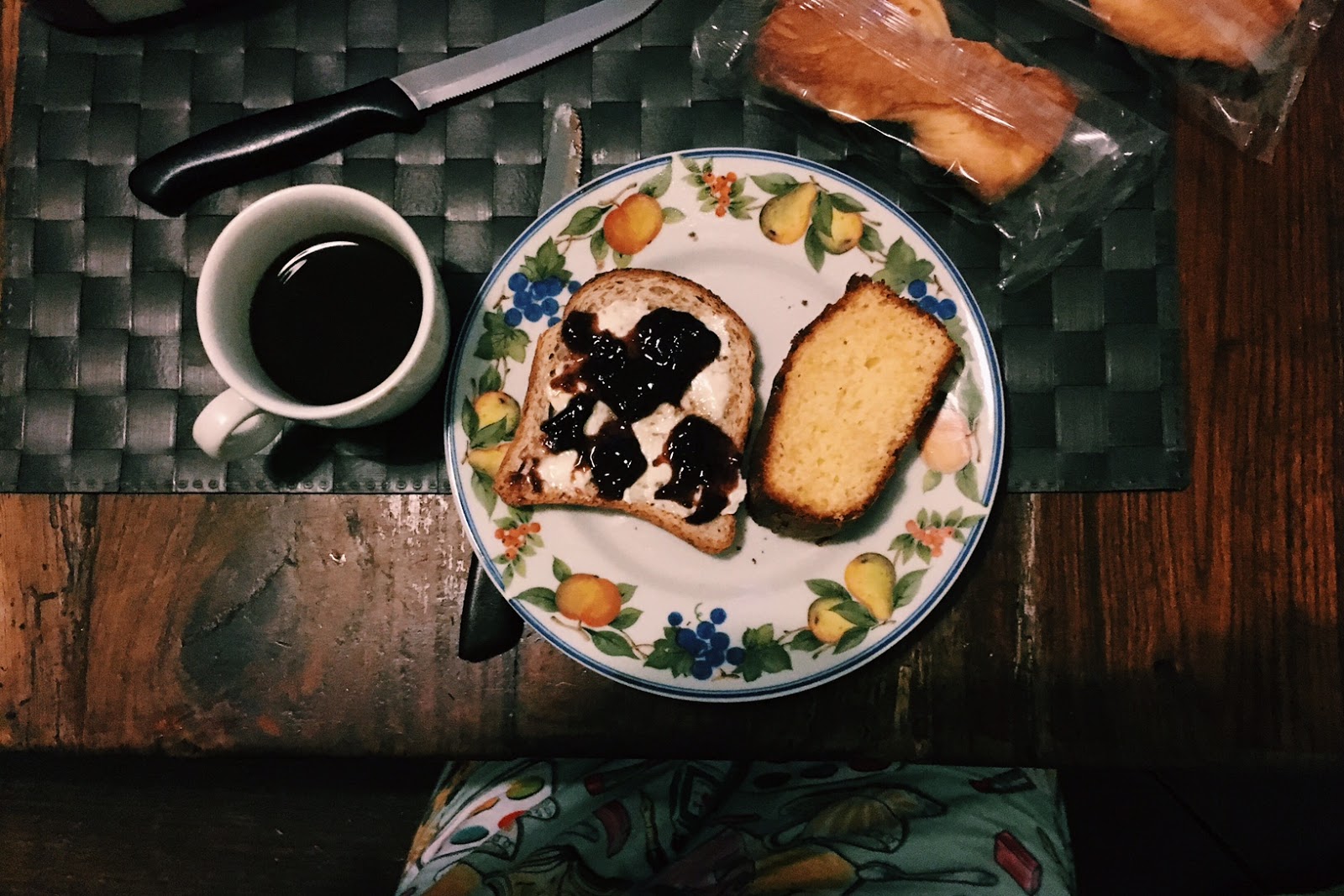
9:00am: After a breakfast of coffee, bread, and delicious homemade jam, it's time to walk to my first class. Art history is always held at a different location. We've visited churches, convents, and museums, and they are all fascinating. We've mostly been focusing on the early renaissance so far, and while I've learned about some of the artists in previous art history classes, a lot of them are new to me. Being on site is a new experience for me, and it's amazing what a difference seeing the work of art in person can make. For instance, it's difficult to really understand WHY Ghiberti's test panel for the bronze doors of the baptistery won the contest over Brunilesci's panel until you see them side by side, in person.

The Ufizi


 12:00pm: Class lets out and we head back to Linguaviva, an Italian language school and the home base of our program. We have an hour and fifteen minutes for lunch. Most of the time I eat food from the supermarket that I store in the Linguaviva fridge, but occasionally I'll get a sandwich from the Mercato Centrale. Last week I tried Lamprodotto (stomach). It was good, if a little chewy for my taste. But I had a nice conversation (in mostly Italian!) with the lady who sold it to me!
1:15pm: Next it's time for my Italian class, with one of my favorite professors on the program. He is this ball of positive energy: always listening, doodling on the board, and talking about how much he loves Michelle Obama. We spend most of the class sharing our homework (usually a prompt like "what's your favorite song/poem/film/etc") and then the rest of it learning grammar. My Italian has improved so much! 


2:30pm: After Italian, I usually walk across the river to the British Institute Library, one of the only English libraries in Florence. I like it because it's a library and I love libraries, but also because it's close to the studio where I have drawing, it has great wifi, and every Thursday they serve high tea. I'm not kidding. Imagine a bunch of little old British ladies serving tea and dessert. It's the best.
5:00pm: My last class of the day is drawing. The class is taught by a rotating trio of British guys, and occasionally a girl, depending on the day. Mostly they are there to give pointers and suggestions while you draw. We are learning a technique called "sight size," in which you stand several feet back from your easel to make your observations and use a string to compare proportions between your drawing and the model. The first few days were a bit rough, and I found myself mentally exhausted after two hours of drawing, but it has gradually gotten more relaxing. Considering that this is the first drawing class I've taken since freshman year of high school, and my first time drawing a live model, I'm doing much better than I expected!  

7:00pm: After class I usually catch the bus home. It's always nice to sit and chat with friends or simply have some quiet time to look out the window. I love crossing the Arno river and seeing the lights reflected in the water.

8:30pm: Dinner! This is always the highlight of my evening. My host parents are excellent cooks. We always have a first course of pasta, a main course of meat and vegetables, and coffee for dessert. The tv is usually on in the background and we always watch a satirical news show called "Stricia Noticia." This usually sparks conversations with our host family about current events, or the two ridiculous female dancers they always feature at the beginning of the show, who never say anything and just smile at the cameras. One of my favorite things we've had for dinner was a pan fried cheese dish that I can't remember the name of unfortunately. I literally ate cheese for dinner, you guys. Italy is perfection.
9:30pm: Thursday's are my busiest days, but luckily the next day is the beginning of the weekend. My evenings are spent listening to audiobooks or podcasts, and catching up with friends from home. Occasionally I'll go for a late night gelato run with my friend Rachel, who lives right around the corner. The gelataria in our neighborhood is open until 1am!
11pm: After a long day, sleep is the only thing I need. Buona note!

I hope you enjoyed this glimpse into my daily routine. Note: not all days are this packed!

By the time you read this, I'll be on a class trip to Rome! Stay tuned for a recap!

Sunday, February 14, 2016

Copenhagen: A Love Letter

Dear Copenhagen,
      You and I have been strangers for most of our lives. I heard about you in songs, maybe a passing reference in a book I was reading. I scrolled past you on Instagram. Until a couple of weeks ago, I never thought we would become acquainted, but somehow, at 5:30 am last Saturday I found myself on a train to Rome to catch a plane to visit you.

The way this trip came about is fraught with turmoil and lots of stumbling. My friend Ela does a great job of recounting it in a recent blog post, but here's the short version: We were looking for a place to go to for a weekend, and we wanted to go out of the country. After looking at Malta, Sicily, Croatia and more we settled on Brussels, Belgium. The catch? As it turns out Brussels is under a high level terrorist watch and travelers are being discouraged from going there. Cue a frantic scramble to find an interesting place that we could exchange our tickets for. That's where you came in, Copengagen, with your palaces and your gardens and the prospect of exploring the same city that Hans Christian Anderson grew up in.

You certainly stole my heart. I love your broad boulevards and your colorful buildings. Your beautiful people with their flawless style and welcoming smiles. The candles on the tables, in the windows of cafes. The glow of warm light onto a cold, dark sidewalk. I love that in the basement of the Christianborg palace, next to the ruins of the fortress walls, is a room for children with crowns and swords and costumes to play dress-up in. My friends and I were kids again in that room.  I love your gardens. The huge greenhouse with the spiral staircases that we arrived at ten minutes after it closed (my only regret). The green statuary, the hedges, the forlorn beauty of it all on a cloudy day. I love that swans are not an uncommon sight. I love that Rosenborg castle still has a moat. You will always be the place where I learned that travel is not for the faint of heart, but also worth all of the stress that comes along with it.

So thank you. Thank you for the laughs and the beauty and the best chicken salad I've ever had. Thank you for the joy of admiring a small but famous statue with 20-some-odd strangers. Thank you for the mall food and the chai latte (the first one I've had since December!), and most of all, for that moment when we first climbed the stairs out of the underground platform and into the heart of the city. Nothing can top the feeling of being in a new place for the first time and the mixture of giddy excitement it inspires. I'll be back someday.

Love,
Laura


Photo by Rachel Lynne Witzig


Saturday, February 13, 2016

Florence, Weeks #4 and 5: In Which I Fall (even more) In Love with Tuscany, Discover Magic in Venice, and Overthink Everything


Sienna and San Gimignano 
A couple of weekends ago we took a group trip to Sienna. I was excited simply for the fact that one my favorite pieces of artwork is there,  which I love for its wonderful strangeness. In the city hall is a room where council members would meet, surrounded by frescoes that depict, rather explicitly, the results of good and bad government. Though it might seem strange today to have images of angels, demons, and hypothetical cities on the walls of a government office, in the renaissance this imagery would have been extremely powerful. On the two longer walls, two cities mirror each other. One is an example of what a city might look like under good government, and the other imagines a city under bad government. In the "good government" fresco, women dance in the streets, buildings are being constructed, and children go to school. In the "bad government" fresco, someone lies dead in the streets, the buildings are crumbling, and thieves run rampant. Ironically, this fresco has been badly damaged, and you're only able to catch glimpses of what's actually happening in the painting. In the other panels, good and bad virtues sit enthroned, personifying the values the council members should adhere to or avoid. I love this fresco for its complexity and all the layers of meaning it holds, but also for it's simplistic view of the world. Good vs. evil, virtue vs. vice. The council members of Sienna would have been deeply familiar with the symbolism in this painting. Unlike our class, which spent twenty minutes figuring out which figure represented which virtue, they would have immediately understood the painting's message and their role in carrying it out. I like to imagine one of them, at the end of a long day, looking up at the walls of this room and thinking to himself, "Don't mess this up."


Sienna is also home to one of the first gothic churches in Italy, and boy was it spectacular. Outside, pink, white, and green marble seems to be pulled upward by stone statues that almost make it look like the building is being held up by people. Inside, grey stone towers above you, with striped columns going all the way down. The church is larger than I expected, and off to one side is an incredible Renaissance chapel. The adjacent museum houses the originals of many of the statues on the facade, as well as one of the oldest intact stained glass windows in the world.


After a long, lovely day in Sienna we stopped over at the small medieval town of San Gimignano. Like most medieval towns, it is built on a hill, and it's isolation has kept it relatively intact, so that many of the structures look just like they did in the 12th century. After passing through one of the main gates into the city, you walk down tiny cobblestone streets to the small center piazza, and then back out the way you came, taking short detours down roads that lead you right to the edge of the hill. The views of the beautiful tuscan countryside alone were enough to win my heart. We unfortunately didn't have time stop for "The World's Best Gelato," but I did get a delicious mystery pastry that I wish I could remember the name of.


Venice
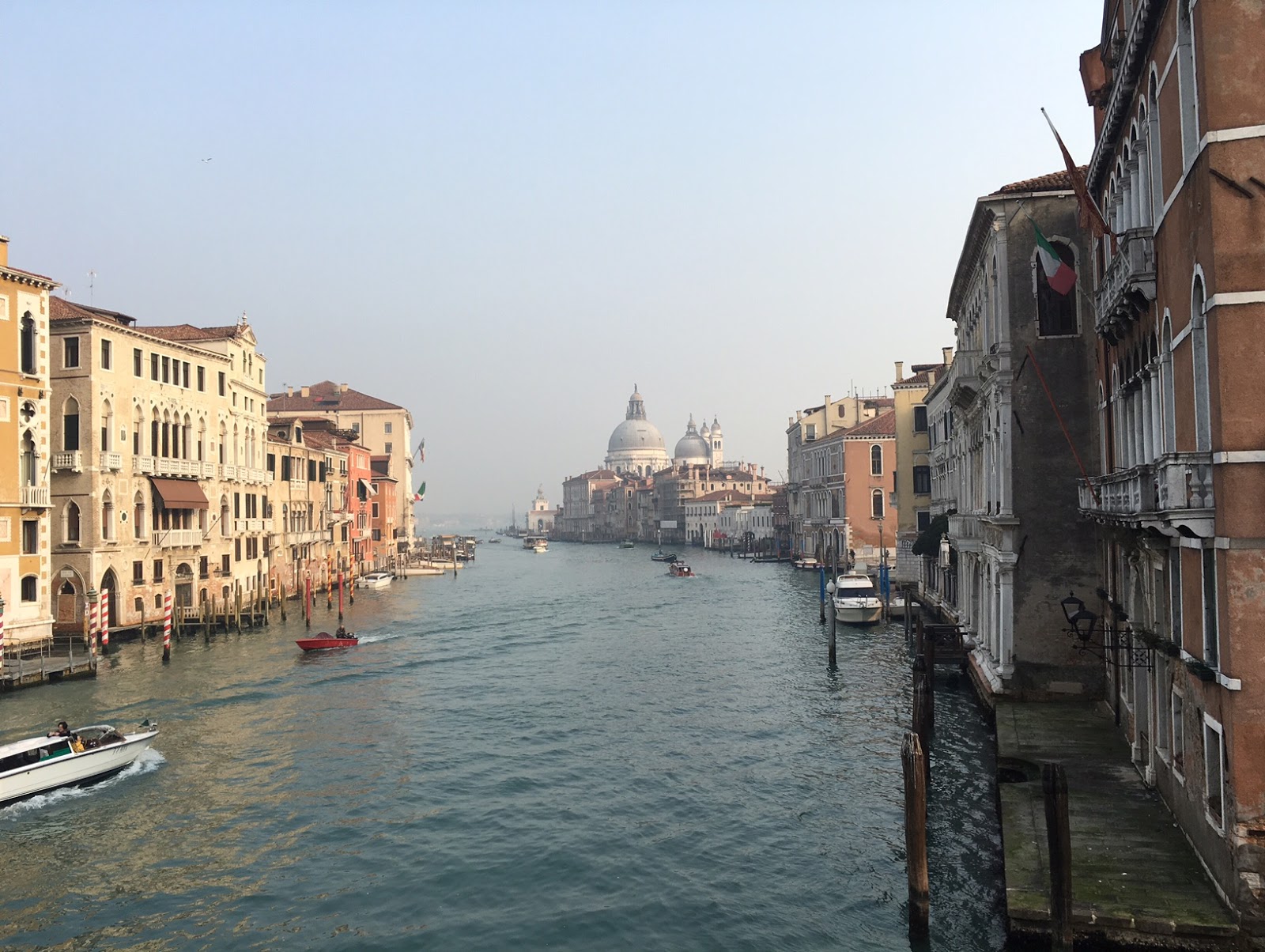
For our program's first weekend outside of Florence, we caught the 8:30am train to Venice. Coming into Venice is probably one of the coolest entrances into any city that I've experienced. The train tracks go over the lagoon that separates Venice from the mainland, but unlike in America where bridges have trusses and guardrails, there was nothing to obstruct our view. It was a foggy morning, and all we could see on either side was a few feet of water, and then a dense, mysterious fog. Boats came rising out of the mist like ghosts. As the edges of the city came into view, I felt like we had traversed some kind of no-man's land in order to arrive in this beautiful place.

View from the train

There's a famous quote from Alice and Wonderland that goes, "I try to believe six impossible things before breakfast." I saw at least three impossible things before dinner on that first day.

Impossible Thing #1: Light
The light in Venice was unlike any I've ever seen. Mist draped itself over the city like a shawl. The truly spectacular moments happened when the sun came out. Golden light filtered through the fog, casting everything in a hazy, unearthly glow. It was as if the whole city was trapped in a perpetual sunset, even at 2 o'clock in the afternoon.

Impossible Thing #2: Glass
One of our first stops was Murano, an island off the coast of Venice where all of the glass-making workshops are. Despite being surrounded by water Venice is extremely fire prone, and after several devastating fires it was decreed that all glass making workshops be moved off of the main island. We stopped into one of the workshops for a free glass blowing demonstration, where I saw someone make a tiny glass horse in about thirty seconds flat. It was probably the closest thing to magic I will ever experience. A glowing, moving ball of heat. A flick of the wrist, a crimp of the tongs, and wala! A tiny glass creature is born.


Impossible Thing #3: Gold
This last one is probably my favorite memory of Venice. It is the moment that I find myself returning to again and again because I will probably never have another experience like it. Somehow, our amazing program director, Jodie, was able to get us into the Basilica of San Marco after hours. Myself and fourteen other people alone in a multi-domed, Byzantine cathedral that seats hundreds.
When we entered the church, it was almost completely dark. There was just enough light to make our way down the center isle, and above us the ceiling arched into nothingness. We were told to sit in the first couple of rows, and wait. Instinctively, we fell silent. At first, it was just darkness, and then slowly, slowly the domes above our heads filled with light. With each new clang from an invisible switch a new part of the shimmery gold sky was illuminated. The ceiling grew from dusty to brilliant right before our eyes. Mosaics floated above our heads like constellations, greens and blues and whites against sea of gold. I got the same feeling I get looking up at a sky full of stars. Suddenly I am insignificant, a body with a head tilted back, shocked into stillness. We stayed this way long after all the lights had come up.


This was not the end of the wonders of San Marco, however. One of the professors on our program (he teaches a class on opera) had gathered a group of students together to sing a canto. They performed it at the front of the church, and the music filled the five domes of San Marco like water. When we were all sufficiently awe-struck, Jodie took us around the church and told us how each part of it was constructed over centuries, with columns from Constantinople and renaissance mosaics placed right next to medieval ones. We were able to stand inches away from an altarpiece that is usually reserved for feast days, and is probably one of the most valuable pieces of art in the world.

The rest of the weekend was wonderful. We were in Venice during Carnivale, which turned a city which is always on display into even more of a spectacle. In one hilarious instance, myself, my friends, and about 200 other people spent forty minutes waiting for fireworks which, when they finally occurred, were on the other side of a wall. I saw beautifully outlandish costumes, and I found myself unexpectedly pining for a green velvet cloak. (Don't ask me where I would wear it - I still want one). Venice, despite its crowds and inescapable self-awareness was absolutely magical.


Lately my brain has been a tangled mess of ideas. I have big plans for 2016. At the beginning of January I made a spreadsheet with my quarterly goals. Quarterly Goals. I don't think I've ever made quarterly goals in my life. Of course my ambition and idealism would manifest itself when I have the least time to devote to random acts of creation, and I'm already trying to adjust to a new place, culture, and language. Nevertheless, for a little while, I was actually keeping up with my overly optimistic schedule. I was making time to write regularly, research summer internships, and post to this blog once a week. All of that changed when I got sick again. It turned out to be less severe than the first cold I had at the beginning of January, but the symptoms were more mysterious and the whole thing messed with my head. I spent a week feeling anxious, isolated, and completely overwhelmed. What I've noticed about studying abroad, and I suppose this is also true of life in general, is that the things that bother you the most are never the things you expect. I expected homesickness, loneliness, even. I didn't expect to feel crazy for panicking over some nonexistent affliction, or to be so exhausted that I missed class in a desperate attempt to catch up on sleep. I'm telling you all of this, not to complain or seem ungrateful, but show you what the happy, idealistic pictures above don't show. Study abroad isn't always fun and it isn't always easy. You have to make the most of your situation, roll with the punches, and know that even the most unpleasant circumstances are only temporary. (And probably not as bad as you think). I'm happy to announce that I'm feeling much better and more like myself as I write this. My head is back to buzzing with ideas, and as usual, I have little to no idea how I'm going to accomplish them. Guess it's time to pull out the spreadsheet.

ps. For the adults reading this, especially my parents, don't worry. I'm not going to overdue it and get sick again!

Ciao, until next time!