"The pages are still blank, but there is a miraculous feeling of the words being there, written in invisible ink and clamoring to become visible." -Vladimir Nobokov

Thursday, February 18, 2016

Florence, Week #6: My Life in Italy

Recently I realized that for all of the details I've given you about the interesting places I've been in Florence, I've told you little to nothing about what a typical day actually looks like. Firstly, here is my somewhat complicated weekly class schedule:

Monday:
1:15-2:30pm: Italian
3:00-4:00pm: Art, Artists, and Patrons (In-Class Lecture)
5:00-7:00pm: Drawing

Tuesday:
9:30am-12:00pm: Art, Artists, and Patrons (On-Site Visit)
1:15-2:30pm: Italian

Wednesday:
1:15-2:40pm: Italian
5:00-7:00pm: Drawing

Thursday:
9:30am-12:00pm: Art, Artists, and Patrons (On-Site Visit)
1:15-2:30: Italian
5:00-7:00pm: Drawing

Friday-Sunday:
Free time, weekend excursions with friends (Copenhagen), or weekend trips with the program (Venice)

Here is what a typical Thursday looks like (just because that's when I have all three of my classes):

8:00am: Usually I'm able to drag myself out of bed by this time. I really wish I was better at getting out of bed. Once I'm up, I'm obnoxiously chipper!


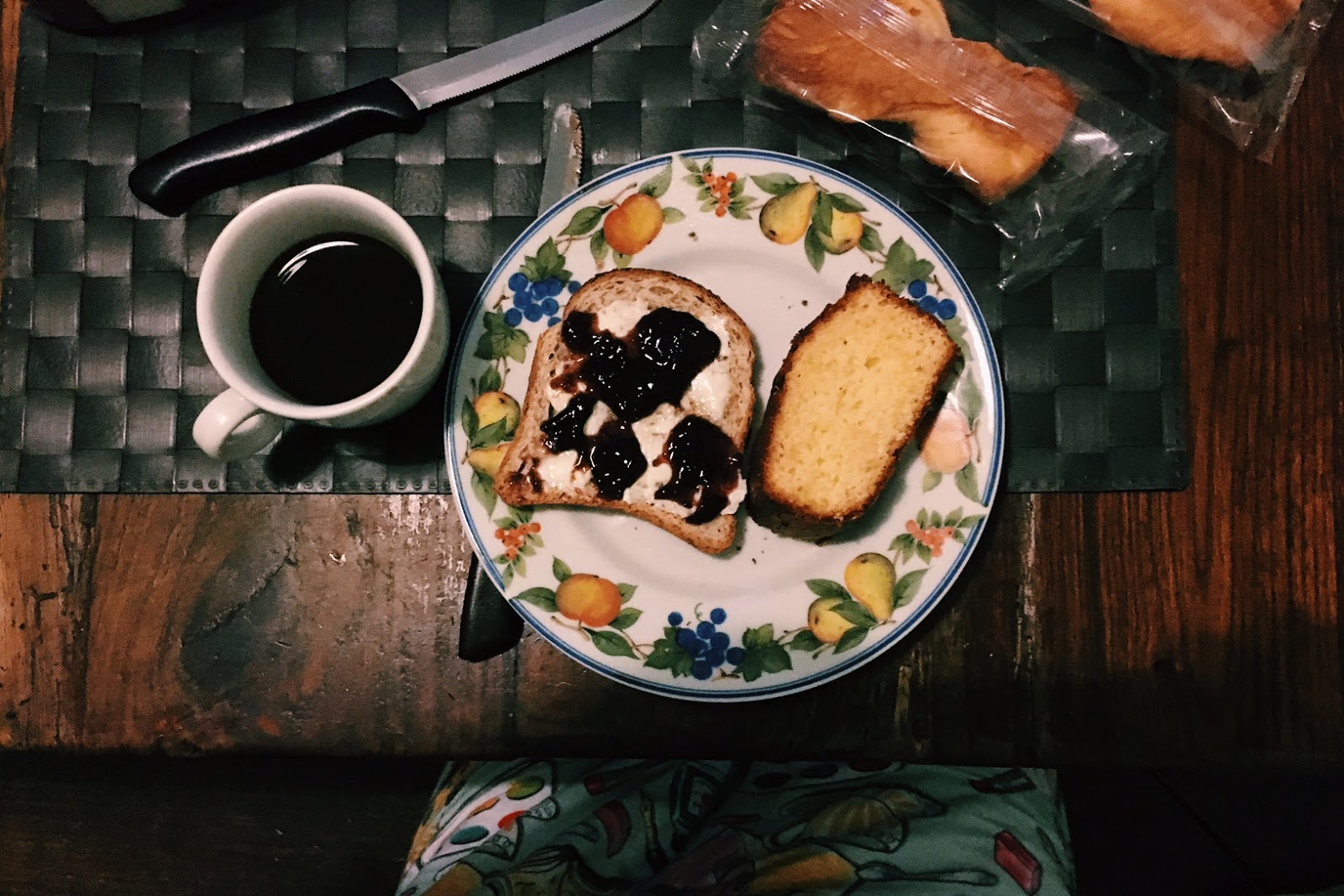
9:00am: After a breakfast of coffee, bread, and delicious homemade jam, it's time to walk to my first class. Art history is always held at a different location. We've visited churches, convents, and museums, and they are all fascinating. We've mostly been focusing on the early renaissance so far, and while I've learned about some of the artists in previous art history classes, a lot of them are new to me. Being on site is a new experience for me, and it's amazing what a difference seeing the work of art in person can make. For instance, it's difficult to really understand WHY Ghiberti's test panel for the bronze doors of the baptistery won the contest over Brunilesci's panel until you see them side by side, in person.

The Ufizi


 12:00pm: Class lets out and we head back to Linguaviva, an Italian language school and the home base of our program. We have an hour and fifteen minutes for lunch. Most of the time I eat food from the supermarket that I store in the Linguaviva fridge, but occasionally I'll get a sandwich from the Mercato Centrale. Last week I tried Lamprodotto (stomach). It was good, if a little chewy for my taste. But I had a nice conversation (in mostly Italian!) with the lady who sold it to me!
1:15pm: Next it's time for my Italian class, with one of my favorite professors on the program. He is this ball of positive energy: always listening, doodling on the board, and talking about how much he loves Michelle Obama. We spend most of the class sharing our homework (usually a prompt like "what's your favorite song/poem/film/etc") and then the rest of it learning grammar. My Italian has improved so much! 


2:30pm: After Italian, I usually walk across the river to the British Institute Library, one of the only English libraries in Florence. I like it because it's a library and I love libraries, but also because it's close to the studio where I have drawing, it has great wifi, and every Thursday they serve high tea. I'm not kidding. Imagine a bunch of little old British ladies serving tea and dessert. It's the best.
5:00pm: My last class of the day is drawing. The class is taught by a rotating trio of British guys, and occasionally a girl, depending on the day. Mostly they are there to give pointers and suggestions while you draw. We are learning a technique called "sight size," in which you stand several feet back from your easel to make your observations and use a string to compare proportions between your drawing and the model. The first few days were a bit rough, and I found myself mentally exhausted after two hours of drawing, but it has gradually gotten more relaxing. Considering that this is the first drawing class I've taken since freshman year of high school, and my first time drawing a live model, I'm doing much better than I expected!  

7:00pm: After class I usually catch the bus home. It's always nice to sit and chat with friends or simply have some quiet time to look out the window. I love crossing the Arno river and seeing the lights reflected in the water.

8:30pm: Dinner! This is always the highlight of my evening. My host parents are excellent cooks. We always have a first course of pasta, a main course of meat and vegetables, and coffee for dessert. The tv is usually on in the background and we always watch a satirical news show called "Stricia Noticia." This usually sparks conversations with our host family about current events, or the two ridiculous female dancers they always feature at the beginning of the show, who never say anything and just smile at the cameras. One of my favorite things we've had for dinner was a pan fried cheese dish that I can't remember the name of unfortunately. I literally ate cheese for dinner, you guys. Italy is perfection.
9:30pm: Thursday's are my busiest days, but luckily the next day is the beginning of the weekend. My evenings are spent listening to audiobooks or podcasts, and catching up with friends from home. Occasionally I'll go for a late night gelato run with my friend Rachel, who lives right around the corner. The gelataria in our neighborhood is open until 1am!
11pm: After a long day, sleep is the only thing I need. Buona note!

I hope you enjoyed this glimpse into my daily routine. Note: not all days are this packed!

By the time you read this, I'll be on a class trip to Rome! Stay tuned for a recap!

Sunday, February 14, 2016

Copenhagen: A Love Letter

Dear Copenhagen,
      You and I have been strangers for most of our lives. I heard about you in songs, maybe a passing reference in a book I was reading. I scrolled past you on Instagram. Until a couple of weeks ago, I never thought we would become acquainted, but somehow, at 5:30 am last Saturday I found myself on a train to Rome to catch a plane to visit you.

The way this trip came about is fraught with turmoil and lots of stumbling. My friend Ela does a great job of recounting it in a recent blog post, but here's the short version: We were looking for a place to go to for a weekend, and we wanted to go out of the country. After looking at Malta, Sicily, Croatia and more we settled on Brussels, Belgium. The catch? As it turns out Brussels is under a high level terrorist watch and travelers are being discouraged from going there. Cue a frantic scramble to find an interesting place that we could exchange our tickets for. That's where you came in, Copengagen, with your palaces and your gardens and the prospect of exploring the same city that Hans Christian Anderson grew up in.

You certainly stole my heart. I love your broad boulevards and your colorful buildings. Your beautiful people with their flawless style and welcoming smiles. The candles on the tables, in the windows of cafes. The glow of warm light onto a cold, dark sidewalk. I love that in the basement of the Christianborg palace, next to the ruins of the fortress walls, is a room for children with crowns and swords and costumes to play dress-up in. My friends and I were kids again in that room.  I love your gardens. The huge greenhouse with the spiral staircases that we arrived at ten minutes after it closed (my only regret). The green statuary, the hedges, the forlorn beauty of it all on a cloudy day. I love that swans are not an uncommon sight. I love that Rosenborg castle still has a moat. You will always be the place where I learned that travel is not for the faint of heart, but also worth all of the stress that comes along with it.

So thank you. Thank you for the laughs and the beauty and the best chicken salad I've ever had. Thank you for the joy of admiring a small but famous statue with 20-some-odd strangers. Thank you for the mall food and the chai latte (the first one I've had since December!), and most of all, for that moment when we first climbed the stairs out of the underground platform and into the heart of the city. Nothing can top the feeling of being in a new place for the first time and the mixture of giddy excitement it inspires. I'll be back someday.

Love,
Laura


Photo by Rachel Lynne Witzig


Saturday, February 13, 2016

Florence, Weeks #4 and 5: In Which I Fall (even more) In Love with Tuscany, Discover Magic in Venice, and Overthink Everything


Sienna and San Gimignano 
A couple of weekends ago we took a group trip to Sienna. I was excited simply for the fact that one my favorite pieces of artwork is there,  which I love for its wonderful strangeness. In the city hall is a room where council members would meet, surrounded by frescoes that depict, rather explicitly, the results of good and bad government. Though it might seem strange today to have images of angels, demons, and hypothetical cities on the walls of a government office, in the renaissance this imagery would have been extremely powerful. On the two longer walls, two cities mirror each other. One is an example of what a city might look like under good government, and the other imagines a city under bad government. In the "good government" fresco, women dance in the streets, buildings are being constructed, and children go to school. In the "bad government" fresco, someone lies dead in the streets, the buildings are crumbling, and thieves run rampant. Ironically, this fresco has been badly damaged, and you're only able to catch glimpses of what's actually happening in the painting. In the other panels, good and bad virtues sit enthroned, personifying the values the council members should adhere to or avoid. I love this fresco for its complexity and all the layers of meaning it holds, but also for it's simplistic view of the world. Good vs. evil, virtue vs. vice. The council members of Sienna would have been deeply familiar with the symbolism in this painting. Unlike our class, which spent twenty minutes figuring out which figure represented which virtue, they would have immediately understood the painting's message and their role in carrying it out. I like to imagine one of them, at the end of a long day, looking up at the walls of this room and thinking to himself, "Don't mess this up."


Sienna is also home to one of the first gothic churches in Italy, and boy was it spectacular. Outside, pink, white, and green marble seems to be pulled upward by stone statues that almost make it look like the building is being held up by people. Inside, grey stone towers above you, with striped columns going all the way down. The church is larger than I expected, and off to one side is an incredible Renaissance chapel. The adjacent museum houses the originals of many of the statues on the facade, as well as one of the oldest intact stained glass windows in the world.


After a long, lovely day in Sienna we stopped over at the small medieval town of San Gimignano. Like most medieval towns, it is built on a hill, and it's isolation has kept it relatively intact, so that many of the structures look just like they did in the 12th century. After passing through one of the main gates into the city, you walk down tiny cobblestone streets to the small center piazza, and then back out the way you came, taking short detours down roads that lead you right to the edge of the hill. The views of the beautiful tuscan countryside alone were enough to win my heart. We unfortunately didn't have time stop for "The World's Best Gelato," but I did get a delicious mystery pastry that I wish I could remember the name of.


Venice
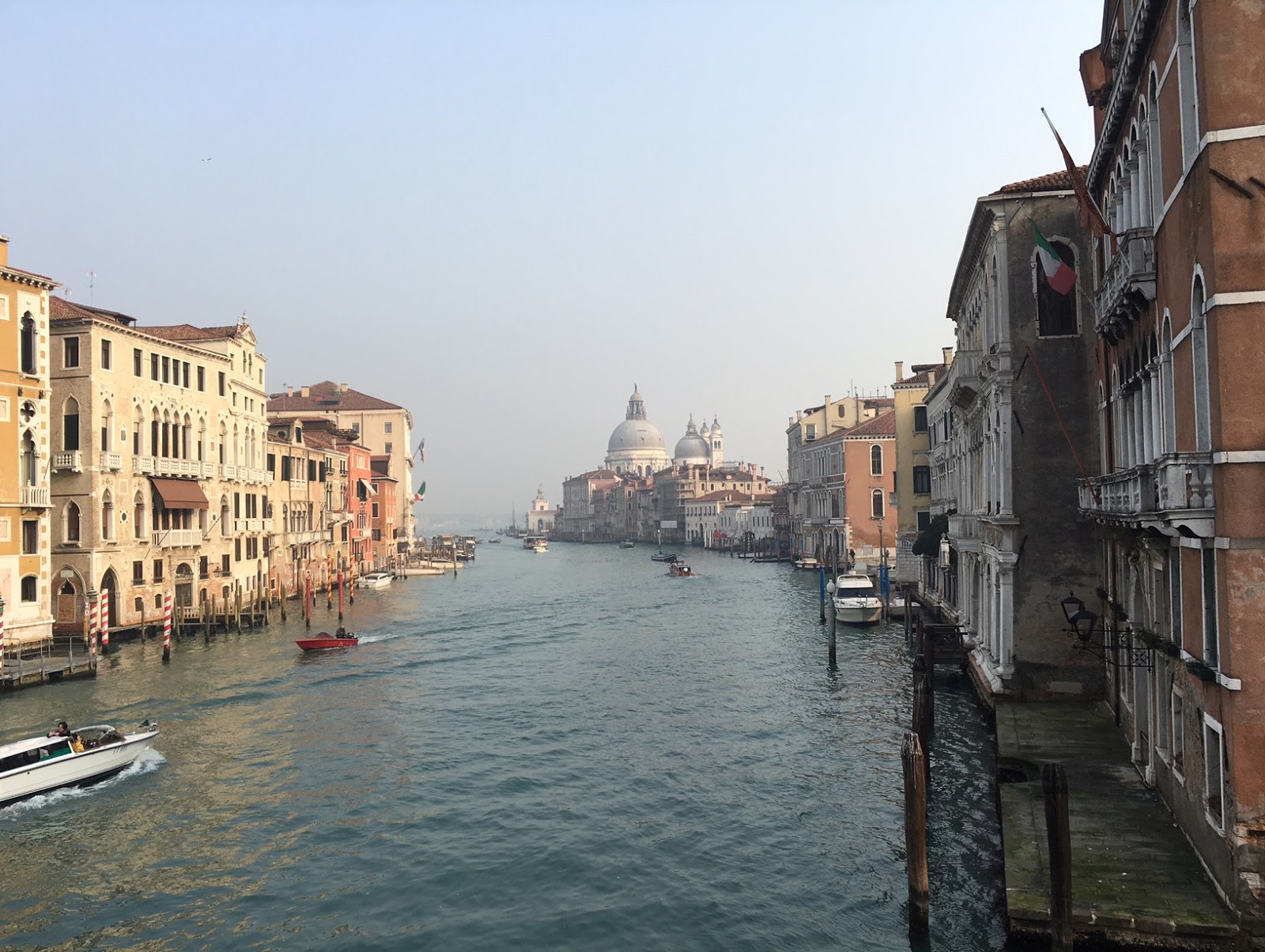
For our program's first weekend outside of Florence, we caught the 8:30am train to Venice. Coming into Venice is probably one of the coolest entrances into any city that I've experienced. The train tracks go over the lagoon that separates Venice from the mainland, but unlike in America where bridges have trusses and guardrails, there was nothing to obstruct our view. It was a foggy morning, and all we could see on either side was a few feet of water, and then a dense, mysterious fog. Boats came rising out of the mist like ghosts. As the edges of the city came into view, I felt like we had traversed some kind of no-man's land in order to arrive in this beautiful place.

View from the train

There's a famous quote from Alice and Wonderland that goes, "I try to believe six impossible things before breakfast." I saw at least three impossible things before dinner on that first day.

Impossible Thing #1: Light
The light in Venice was unlike any I've ever seen. Mist draped itself over the city like a shawl. The truly spectacular moments happened when the sun came out. Golden light filtered through the fog, casting everything in a hazy, unearthly glow. It was as if the whole city was trapped in a perpetual sunset, even at 2 o'clock in the afternoon.

Impossible Thing #2: Glass
One of our first stops was Murano, an island off the coast of Venice where all of the glass-making workshops are. Despite being surrounded by water Venice is extremely fire prone, and after several devastating fires it was decreed that all glass making workshops be moved off of the main island. We stopped into one of the workshops for a free glass blowing demonstration, where I saw someone make a tiny glass horse in about thirty seconds flat. It was probably the closest thing to magic I will ever experience. A glowing, moving ball of heat. A flick of the wrist, a crimp of the tongs, and wala! A tiny glass creature is born.


Impossible Thing #3: Gold
This last one is probably my favorite memory of Venice. It is the moment that I find myself returning to again and again because I will probably never have another experience like it. Somehow, our amazing program director, Jodie, was able to get us into the Basilica of San Marco after hours. Myself and fourteen other people alone in a multi-domed, Byzantine cathedral that seats hundreds.
When we entered the church, it was almost completely dark. There was just enough light to make our way down the center isle, and above us the ceiling arched into nothingness. We were told to sit in the first couple of rows, and wait. Instinctively, we fell silent. At first, it was just darkness, and then slowly, slowly the domes above our heads filled with light. With each new clang from an invisible switch a new part of the shimmery gold sky was illuminated. The ceiling grew from dusty to brilliant right before our eyes. Mosaics floated above our heads like constellations, greens and blues and whites against sea of gold. I got the same feeling I get looking up at a sky full of stars. Suddenly I am insignificant, a body with a head tilted back, shocked into stillness. We stayed this way long after all the lights had come up.


This was not the end of the wonders of San Marco, however. One of the professors on our program (he teaches a class on opera) had gathered a group of students together to sing a canto. They performed it at the front of the church, and the music filled the five domes of San Marco like water. When we were all sufficiently awe-struck, Jodie took us around the church and told us how each part of it was constructed over centuries, with columns from Constantinople and renaissance mosaics placed right next to medieval ones. We were able to stand inches away from an altarpiece that is usually reserved for feast days, and is probably one of the most valuable pieces of art in the world.

The rest of the weekend was wonderful. We were in Venice during Carnivale, which turned a city which is always on display into even more of a spectacle. In one hilarious instance, myself, my friends, and about 200 other people spent forty minutes waiting for fireworks which, when they finally occurred, were on the other side of a wall. I saw beautifully outlandish costumes, and I found myself unexpectedly pining for a green velvet cloak. (Don't ask me where I would wear it - I still want one). Venice, despite its crowds and inescapable self-awareness was absolutely magical.


Lately my brain has been a tangled mess of ideas. I have big plans for 2016. At the beginning of January I made a spreadsheet with my quarterly goals. Quarterly Goals. I don't think I've ever made quarterly goals in my life. Of course my ambition and idealism would manifest itself when I have the least time to devote to random acts of creation, and I'm already trying to adjust to a new place, culture, and language. Nevertheless, for a little while, I was actually keeping up with my overly optimistic schedule. I was making time to write regularly, research summer internships, and post to this blog once a week. All of that changed when I got sick again. It turned out to be less severe than the first cold I had at the beginning of January, but the symptoms were more mysterious and the whole thing messed with my head. I spent a week feeling anxious, isolated, and completely overwhelmed. What I've noticed about studying abroad, and I suppose this is also true of life in general, is that the things that bother you the most are never the things you expect. I expected homesickness, loneliness, even. I didn't expect to feel crazy for panicking over some nonexistent affliction, or to be so exhausted that I missed class in a desperate attempt to catch up on sleep. I'm telling you all of this, not to complain or seem ungrateful, but show you what the happy, idealistic pictures above don't show. Study abroad isn't always fun and it isn't always easy. You have to make the most of your situation, roll with the punches, and know that even the most unpleasant circumstances are only temporary. (And probably not as bad as you think). I'm happy to announce that I'm feeling much better and more like myself as I write this. My head is back to buzzing with ideas, and as usual, I have little to no idea how I'm going to accomplish them. Guess it's time to pull out the spreadsheet.

ps. For the adults reading this, especially my parents, don't worry. I'm not going to overdue it and get sick again!

Ciao, until next time!
Sunday, January 24, 2016

Florence, Week #3: Gratitude, Gelato, and Galileo's Finger

Fiesole

In the days leading up to my departure for Florence, one of the many questions that came to me uninvited while I was trying to fall asleep was "Will I make friends?" I only knew one other person from my school going on this trip, and at the time we were just friendly acquaintances. Three weeks in, I'm proud to announce that I had absolutely no trouble making friends, and they are some of the most kind, interesting, and curious people I've come into contact with. These are people who are unafraid to take silly photos with you at beautiful scenic overlooks. People who will laugh with you for ten minutes about some silly Italian phrase, and who will never judge you for eating gelato twice in one day. I've been thinking about the word gratitude, lately. Maybe I've seen it too many times in hashtags like #dailygratitude, but it's a word that's always felt a bit trite to me. I could tell you I'm grateful for my friends, for this opportunity to study in such a fascinating, beautiful county. What you wouldn't see is the stupid smile I get when it suddenly hits me that I'm here, walking on cobblestone streets with my freezing fingers wrapped around a cup of gelato. You wouldn't feel the same immense comfort I feel at being around people who really listen to what I have to say and always offer some new insight in return. It's not always easy to feel this way. Now that the newness of being here has worn off a bit, I have to fight to keep from taking things for granted, settling into too much of a routine, thinking I've seen everything when really I've barely scratched the surface. It's human nature to adapt to new places quickly, to connect the dots while skipping over some of the more nuanced points. Seeing everything anew is a daily choice, and one that so far, I think I'm doing an ok job of making.


Last Saturday, my friends Lia, Rachel, Ciera and I took the bus from Piazza San Marco to Fiesole, a small town nestled in the hills above Florence. We wound through the outskirts of the city and then up, higher and higher. The view grew more breathtaking with each glimpse we caught through the trees. Fiesole was sleepy when we got there, and stayed that way all afternoon. We were dropped off at the center piazza in front of a structure with a tower much like the one attached to Palazzo Vecchio. We immediately climbed a steep hill, Rachel and I complaining loudly all the while. We explored a small park at the top, and I couldn't help thinking how nice it would be to live in one of the cluster of houses that populated the surrounding hills. We stopped for lunch at a cute place near the center of town. The staff was lively and friendly, and I had some delicious (and reasonably priced) lasagna. The waitress made fun of me for eating slowly: "We're open until 8pm, you know!" and my friends and I laughed for way too long at the mis-translated sign on the front door advertising "Hot Chocolate with Ron" which was supposed read "Hot Chocolate with Rum." From then on our waiter was dubbed "Ron."As the sun dipped lower in the sky we climbed yet another hill, until we stumbled on a lookout point even more beautiful than the first. Florence lay below us, already in shadow, while a small group of locals gathered to watch the spectacle of the clouds rolling in over the hills. It was stunning.

Another highlight of my week was visiting the Galileo Museum. It's full of scientific instruments from medieval times to the 1700s, and it all comes from the private collection of two families, which just goes to show how powerful the wealthy families of Florence really were. Our tour guide was a lively woman from California who reminded me of a cross between Mary Poppins and Mrs. Frizzle. She carried a cloth, over-the-shoulder bag, and every so often she would rummage through it and pull out a rubber ball, or kaleidoscope, or even a tiny plastic globe to illustrate what she was talking about. Her tour was energetic and a little sporadic, and every so often she would stop mid sentence to comment on how much she loved someone's sweater, or recommend a gallery show she'd seen recently. In addition to learning fascinating information about Galileo and the objects in the museum, she also told us the best way to pace yourself at dinner so as not to offend your host family (The trick: take a small serving first so that you can ask for seconds later), where to find non-Italian foods like peanut butter and tortilla chips, and what pharmacy to go to if you're sick. All in all the tour was a lot of fun, and the museum was so interesting and there was so much to see, that I might end up going back. My favorite items were the pocket sun-dials carried by the wealthy before there were pocket watches, this giant globe in which each rotating ring represents a different planet with the earth (instead of the sun) at its center, and a giant static electricity machine which seemed like it could have come right out of Frankenstein. The museum also housed Galileo's only surviving telescopes, as well as his thumb and index finger, preserved in a glass jar like a relic. Creepy, but cool!

Pocket Sundials 


Yesterday we visited the Tuscan towns of Sienna and San Gimignano, but I have so many beautiful pictures that I think it deserves its own post. In other news, next week we begin regular classes instead of our three week Italian intensive. I'll be taking an art history class about patronage and the arts (specifically the Medici family) and a drawing class at an old fashioned studio in Florence. I'm excited and a little nervous about that one, but I couldn't pass up the opportunity to take a drawing class in Florence, the birthplace of the Renaissance. Week three has been the best so far, and I can't wait to see what the next has in store!


Saturday, January 16, 2016

Some Late Night Thoughts on The Art of Asking by Amanda Palmer

It's 1am here and I just finished listening to Amanda Palmer's The Art of Asking on audiobook. Amanda is a cult-y, free-spirited musician with painted on eyebrows who, I have to admit, I wrote off for a while because I thought I didn't like her music. I was wrong. I thought that I wouldn't really like her book, that it's subject matter, which as the title suggests, is about asking people (friends, family, audience members, fans, strangers) for help when you need it (in the form of money, places to stay, or just a hug), wouldn't be for me. I was wrong again.

The Art of Asking is a fantastic book. Listening to Amanda read it on audiobook was kind of like sitting down to a long conversation with a friend - those conversations where you share deepest fears, insecurities, and dreams, and the only thing that matters is that you are two people in a moment, connecting. According to Amanda asking for things and being willing to accept the answer, whatever it may be, is the basis for all human connection. If this book were a person, the idea that people have an innate ability to really, truly understand one another, even in seemingly contrived situations, would be coursing through its veins. Amanda writes about her time working as a living statue in a public square in Boston, her marriage to Neil Gaiman, her crazy, exuberant fan base and the shenanigans they get up to, and her best friend Anthony. Though the anecdotes seem disconnected, they somehow weave themselves into a network of interconnectedness, which is fitting because it's exactly how Amanda believes the world works. I was struck by her bravery and her trust in strangers, when so many of us are taught to fear even our next-door neighbors. I admired the way she wrote about friendship, because it's something I always struggle to put into words. The bond I have with my best friend feels like it has to be witnessed in person for you to really understand it, and yet as I read Amanda's account of her life-long friendship with Anthony I saw a lot of the same qualities in my own friendships.

I think The Art of Asking should be required reading for everyone. Especially artists, for whom asking support from their audience is doubly important. It's one of those books that will make you a better person, and teach you something about human nature that you might have thought was possible, but didn't believe yet. I recommend the audiobook, not only for Amanda's deep, soothing voice, but also because you get to listen to her songs every few chapters. I listened to the entire 11-hour audio book in the span of three days. But anyway, it's late. I'm glad this was my first read (listen?) of 2016. It was a good start.

If you want a taste, watch Amanda's TED talk, which was the inception for the book, and equally fantastic.

Florence, Week #2: In Which I Go Exploring, Discover a Kind of Time Travel, and Spend A Lot of Time Looking Up

Last Sunday I found myself with a rare day to myself, and mustered up the courage to strike out on my own. I decided on an oddly shaped patch of green space that google maps assured me was a ten minute walk from my host family's apartment building. One thing you should know about me: I love gardens. Especially European gardens. Most of the parks in America (and I'm generalizing here) feel flat and uninteresting, with concrete sidewalks and maybe a collection of trees for shade. In the States, you go to the park for a purpose: to exercise or walk your dog or play frisbee. European gardens feel like a place for wandering.Wether it's a maze of square trees in Paris or the more wild landscape of the Italian gardens I've seen, European gardens feel more like an escape.
The walk to the park was a little confusing, what with the slightly harrowing traffic signals and a couple of narrow tunnels under the rail road tracks, but when I arrived, I knew it was worth it. After passing through the wrought-iron front gates, you climb a set of cracked stone steps up to the Villa Fabbricotti, a small but impressive-looking building who's purpose I'm not sure of. From the top of the hill you get a nice little view of the city in between the trees. The narrow streets and rumble of traffic feels miles away.

I spent a good hour and a half exploring the park, which is divided into two sections. The most impressive section was the grounds of the Museo Stibbert, which was full of mysterious ivy-covered walls, pathways guarded by statues, and even an imitation egyptian temple on the bank of a pond. Maybe it's because I'm listening to it on audiobook, but I couldn't help feeling like Mary Lennox discovering the secret garden. There's definitely something to be said for wandering for its own sake, especially when you're traipsing along muddy paths and pretending to be straight out of the pages of an edwardian children's book.


On Monday we visited the Palazzo Vecchio. The amazing thing about so many monuments in ancient cities like Florence, is that a lot of them are built on the sites of old roman structures. The Palazzo Vecchio was built on top of the Roman theatre. Amazingly, you can walk around below the Palazzo and see the ruins of the theatre. There were places where medieval stone work gave way to the ruins of ancient structures. Jodie, the director of the program, always talks about "reading buildings" in order to understand their history, and looking at the layers of stone underneath the Palazzo Vecchio felt a bit like seeing time itself layered in physical space. The Palazzo itself was absolutely stunning. Jodie told us how it had oscillated between being a public building to being the palace of the Medici family, and it was interesting to see how the decorative frescoes or intricate ceiling murals reflected the passing between families and generations, and how their meanings changed with each new inhabitant. We stood in the grand hall where frescoes by DaVinci and Michelangelo had once been displayed side by side (though neither were ever completely finished), and stood in the atrium for ten minutes "reading" the multiple architectural styles that had been added on over the centuries. One of the most amazing things about the Palazzo Vecchio is that even though the majority of it is a museum, it's still Florence's city hall building, and the back rooms house the mayor's and city council offices.


On Wednesday we toured the Duomo and baptistery. Like the Palazzo Vecchio, these buildings were also built on top of ancient structures, and underneath the duomo you can still see remnants of pre-Christian mosaic floors, and parts of the smaller romanesque cathedral that stood before the new one was built. Both buildings have stunning ceilings, with the breathtaking mediaeval mosaics of the baptistery and the Renaissance fresco on the inside of Brunilesci's dome. Needless to say, I spent a lot of time with my head thrown back, marveling at the sheer beauty of it all. It's interesting to imagine what these spaces must have looked like to a renaissance Florentine, and how powerful these images would have been. (Not that they are any less moving today, but to watch the cathedral being built and to experience the power of Vasari's frescoes for the first time would have been amazing). Seeing these places and understand their history from their foundation up, it's easy to feel strangely timeless, as though you can jump centuries just by shifting your gaze.


So far I've been learning and experiencing so much that it's hard to distill into words. I'm not sure what memories will be more important to me: the things I learned about history and culture, or the little moments and inside jokes I shared with friends between classes. As of right now, I'm just trying to document everything as best I can: keeping a journal, writing things people say in my notebook, and publishing on this blog. I've also been feeling the itch I get when I haven't written creatively in a while. Stay tuned for a post next week about staying creative while abroad. (Hint: it's not easy, but it's doable).

Until next time, ciao!

Incredible early-morning view from my Italian classroom